
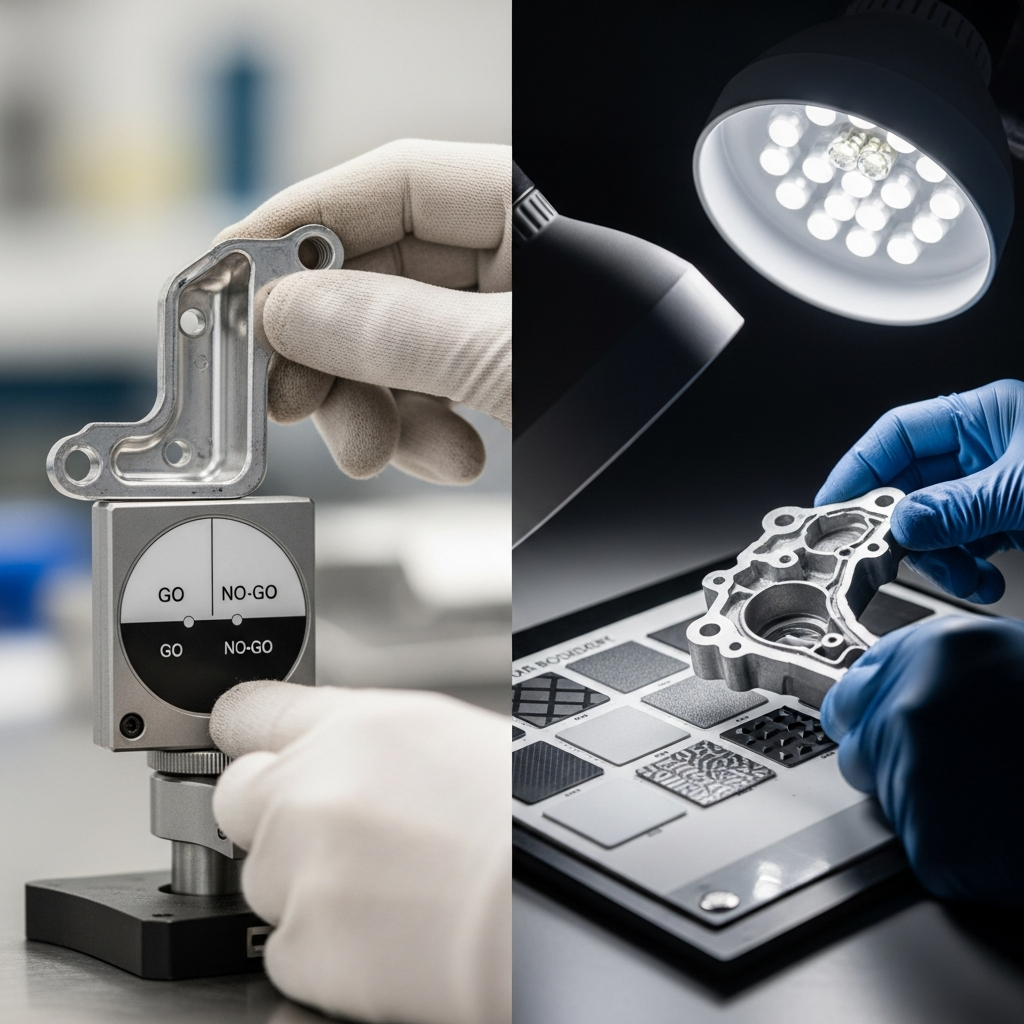
Visual vs. Gauge Sorting: Choosing the Most Efficient Method for Defect Detection
Optimizing your quality firewall requires the right tools. We break down when to use human visual acuity and when to rely on physical attribute gauging.
In the world of manual sorting automotive components, efficiency is driven by one thing: the repeatability and reproducibility (Gage R&R) of your inspection process. When a quality spill occurs, the first technical hurdle is determining how to separate "good" from "bad" with 100% accuracy.
The two primary weapons in a sorting team's arsenal are visual sorting services and gauge sorting. While both aim for zero defects, the application, speed, and cost-effectiveness of each method vary wildly depending on the defect type.
Gauge Sorting: The Gold Standard for Dimensional Precision
Gauge sorting utilizes physical "Go/No-Go" attribute gauges. These are precision-machined tools designed to check a single specific feature, such as a hole diameter, thread pitch, or overall length.
When to Choose Gauging:
- Dimensional Features: When the defect involves tight tolerances that the human eye cannot accurately measure.
- Objective Passing: A part either fits the gauge or it doesn't. This eliminates "Type II" errors (accepting a bad part) due to inspector fatigue.
- High-Volume Consistency: For high-speed checks of fasteners, brackets, or machined surfaces where a physical stop is faster than a visual scan.
Visual Sorting: Mastery of Aesthetics and Form
Despite advances in machine vision, the human eye remains incredibly effective at identifying complex, non-dimensional defects. Visual sorting services are essential for "subjective" quality criteria that a physical gauge simply cannot detect.
When to Choose Visual Inspection:
- Surface Defects: Identifying scratches, burrs, dents, or "short-shots" in plastic injection molding.
- Color and Finish: Verifying paint consistency, chrome plating quality, or fabric grain orientation.
- Complex Geometry: When a part has multiple features in close proximity where a gauge would be too bulky or slow to apply.
The PTI Difference: Standardizing the Subjective
The biggest risk in visual sorting is subjectivity—where one inspector's "pass" is another's "fail." At PTI, we eliminate this risk through Boundary Samples and Master Defect Catalogs.
By placing physical examples of the "worst-case good" and "best-case bad" parts directly at the sorting station, we provide our team with a clear visual reference that mimics the objectivity of a gauge.
| Metric | Gauge Sorting | Visual Sorting |
|---|---|---|
| Accuracy | High (Absolute) | Moderate to High (Depends on training) |
| Setup Speed | Slower (Requires tool calibration) | Fast (Requires work instructions) |
| Ideal For | Threads, Holes, Tolerances | Aesthetics, Surface, Color |
Not Sure Which Method You Need?
Our quality engineers analyze your defect types to develop the most cost-effective and accurate sorting protocol for your specific crisis.
Consult with a Quality Expert